Download now


22 November, 2026
Sublimation vs DTF Printing for Jerseys: Which Is Better for Your Team?
15 November, 2026 | Rigid Sportswear Team
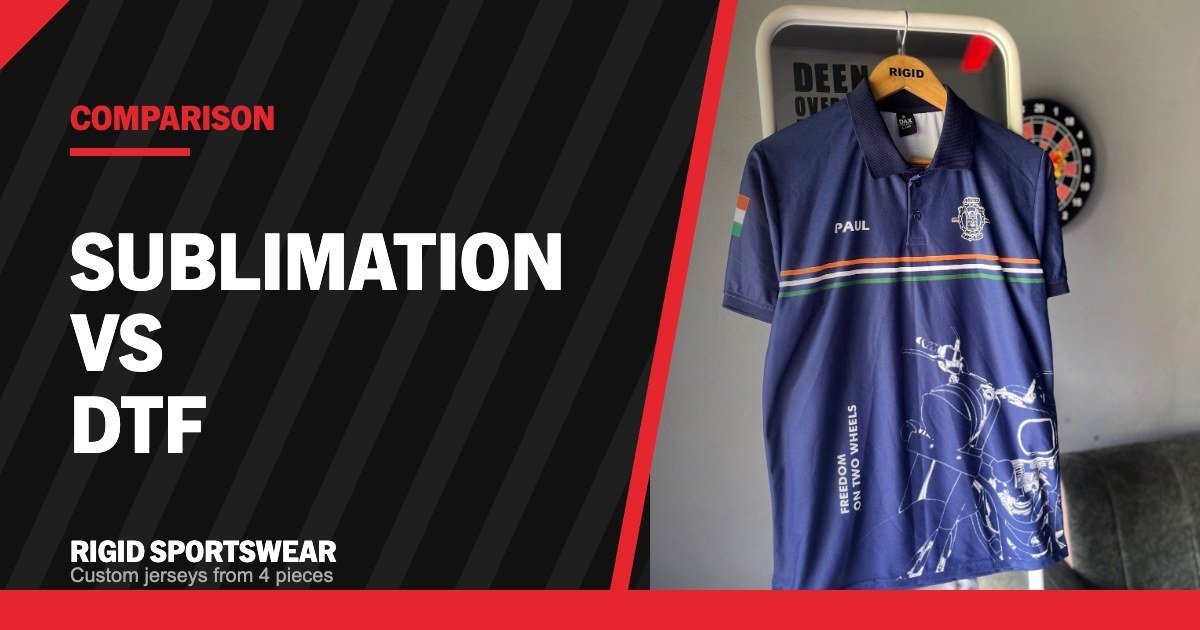
Quick answer: For polyester sports jerseys, sublimation is better: the design is dyed into the fabric, so it never cracks, peels or adds weight, and you can print full-colour designs edge to edge. DTF printing is better for cotton T-shirts, dark garments and adding small logos or names to ready-made clothing.
Sublimation and DTF (direct-to-film) are two of the most popular ways to print custom team wear today. Both can produce bright, detailed designs, but they work in very different ways, and choosing the wrong one can mean a jersey that feels heavy, cracks after a few washes or simply cannot be printed on your chosen fabric. Here is how the two methods compare.
How Sublimation Printing Works
In sublimation printing, the design is printed onto special paper with sublimation inks. Under heat and pressure, the ink turns into a gas and bonds with the polyester fibres. When it cools, the design becomes part of the fabric itself rather than a layer on top. That is why sublimated jerseys feel exactly like plain fabric and stay breathable.
How DTF Printing Works
In DTF printing, the design is printed onto a clear film with a white ink base underneath. An adhesive powder is applied, the film is cured and then heat-pressed onto the garment. The print sits on top of the fabric as a thin, flexible layer.
Sublimation vs DTF: Side-by-Side
| Sublimation | DTF | |
|---|---|---|
| Fabric | Polyester (white or light base) | Cotton, polyester, blends, dark fabrics |
| Print area | Full garment, edge to edge | Logos, names and designs of set sizes |
| Feel | No feel; part of the fabric | Thin layer on top of the fabric |
| Breathability | Unchanged | Reduced where the print sits |
| Durability | Does not crack or peel | Durable, but can crack or lift over time |
| Colours | Unlimited, including gradients | Unlimited, including gradients |
| Best for | Team jerseys and sportswear | Cotton T-shirts, hoodies, small logos |
When to Choose Sublimation
- You want a fully custom sports jersey with patterns, gradients and sponsor logos anywhere on the garment.
- The kit will be worn and washed often, such as for weekly matches or a full season.
- Players need a light, breathable jersey for hot weather or high-intensity sport.
- You want names and numbers that never peel off.
When to Choose DTF
- You are printing on cotton or dark-coloured garments, such as event T-shirts and hoodies.
- You only need a logo or name on a ready-made garment.
- The design covers a small area, so breathability is not a concern.
Cost: Which Is Cheaper?
With sublimation, the whole garment is printed in one process, so adding more colours, patterns or sponsor logos does not increase the cost. The price mainly depends on the fabric and quantity. With DTF, the cost depends on the size and number of print areas: a small chest logo is inexpensive, but large front and back prints add up quickly. For a fully designed team jersey, sublimation is usually the better value. For a single logo on a cotton T-shirt, DTF is often cheaper.
Washing and Care
Sublimated jerseys are easy to care for: wash inside out in cool water and avoid bleach. DTF prints last longer if you wash the garment inside out, avoid tumble drying on high heat and never iron directly over the print.
What About Screen Printing and Embroidery?
Screen printing is still a good option for large runs of simple one- or two-colour designs on cotton, and embroidery gives polos, caps and jackets a premium, long-lasting finish. Our guide to screen printing vs sublimation compares those two in more detail.
Our Recommendation
For match jerseys, training kits and most team sportswear, choose sublimation on a breathable polyester such as Salina or Dot knit. For supporter T-shirts in cotton, staff hoodies or adding a logo to existing clothing, DTF is often the practical choice. Many teams use both: sublimated jerseys for players and DTF-printed cotton tees for fans and volunteers.
Rigid Sportswear makes fully sublimated jerseys from 4 pieces per design, with a free mock-up, 4–7 days of production after approval and 3–9 days of delivery. See our sublimation jersey manufacturing page or the price list to get started.
Frequently Asked Questions
Is sublimation better than DTF for sports jerseys?
For polyester sports jerseys, yes. Sublimation dyes the design into the fibres, so it does not crack, peel or add weight, and the jersey stays breathable. DTF is better suited to cotton garments and small logos.
Can sublimation be used on cotton T-shirts?
No. Sublimation only bonds properly with polyester fabric. For cotton T-shirts, DTF or screen printing is the better option.
Does DTF printing crack or peel?
DTF prints are durable when applied correctly, but because the print sits on top of the fabric, it can crack or lift over time with heavy washing, stretching or ironing.
Which printing method is better for small quantities?
Both work for small quantities. Sublimation is best for full-colour team jerseys from 4 pieces; DTF is convenient for adding logos or names to ready-made garments.
Related Guides
More from our Fabric and Printing series:
- Screen Printing vs Sublimation: Which Is Best for Bulk Orders?
- Sublimation vs. Standard Polyester: A Fabric & GSM Guide for Team Jerseys
- How to Choose the Right Fabric GSM for Custom Sports Jerseys
- Cotton vs Polyester Fabric: Which Is Best for Custom Jerseys?
- Beyond the Logo: Subtle Branding Techniques for Team Wear
Recent Posts
Custom Volleyball Jersey Guide: Design, Fit a
Football Jersey Design Ideas: A Practical Gui
What Is a Jersey Mock-Up and How Do You Appro
How to Wash Sublimation Jerseys So the Prints
10 Mistakes to Avoid When Ordering Custom Jer
How to Measure Jersey Size and Collect Sizes
Categories